Home → Services → Storm Drain Cleaning
Storm Drain Cleaning in Enid, OK
A storm drain on a house carries rainwater away from the roof and the foundation through a buried line. When that line clogs, the downspout backs up, water spills over the gutter, or a puddle sits against the house after the rain stops. Storm drain cleaning in Enid, OK clears that buried line so rainwater drains away from the house again.
What counts as a storm drain on a house?
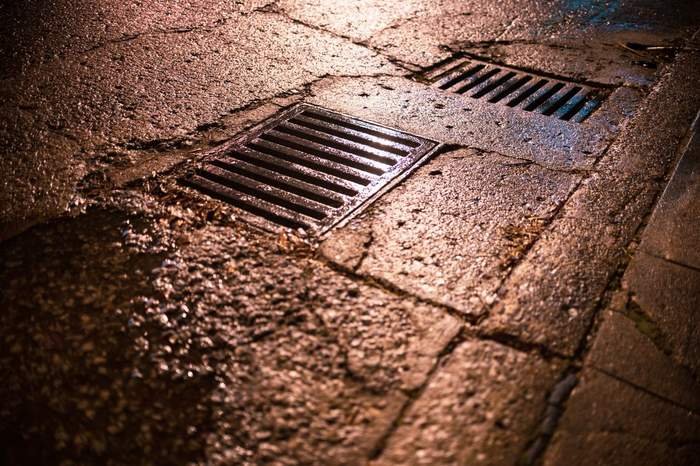
A residential storm drain is the drain that handles rainwater, not wastewater from inside the house. It starts at the downspout, where rainwater leaves the gutter, and runs through a buried pipe to a discharge point away from the house — a pop-up emitter in the yard, a curb outlet, or a dry well. A grate at ground level, where one exists, keeps leaves and larger debris out of the line.
The buried part is what makes a storm drain different from a gutter. Gutters and downspouts are above ground and visible; the storm drain line is underground, so a clog in it cannot be seen from the yard. Water backing up at the downspout is the first sign that the buried line, not the gutter, is blocked.
How do you know the storm drain is clogged?
- Water backs up and spills out of the downspout during rain, instead of flowing down into the buried line.
- The gutter overflows in a normal rain, even though the gutter itself looks clear of leaves.
- Water pools at the base of the downspout or against the foundation after rain, and the puddle stays after the rain stops.
- The pop-up emitter at the end of the line stays dry in heavy rain while water backs up at the house — water is not reaching the end of the line.
- The same downspout backs up every time it rains hard, not just once after a storm.
One downspout backing up points to that downspout’s buried line. Every downspout backing up at once points further down — to the main line or the shared outlet. Describe which downspouts are affected on the call.
Why do storm drains clog in Enid?
Leaves and roof debris. Leaves, twigs, and shingle grit wash off the roof in every rain and settle in the buried line. A grate at the downspout catches the larger pieces, but fine debris passes through and builds up at bends and low spots in the pipe.
Sediment and silt. Rainwater carries fine dirt and silt into the line. Over time it settles in the pipe, narrows the opening, and slows the flow until a heavy rain overwhelms it. A line that handled light rain fine can fail in the first hard rain of the season.
Root intrusion. Mature trees send roots toward the steady moisture inside a buried drain line. Roots enter through a loose joint or a small crack and grow into a mat that catches leaves and silt until the line closes off. Root intrusion is a common cause of a storm drain clog that keeps coming back after a simple flush.
A settled or crushed pipe. A buried line can settle at a joint or be crushed where the ground above it is driven over or built on. The pipe sags, water pools in the low spot, and sediment collects there until the flow stops. A settled pipe cannot be cleared to full flow by cleaning alone, and a camera check is how that is found out.
Mineral scale in older lines. Mineral scale builds up on the inside wall of older pipes and narrows them. Scale on its own rarely closes a line, but a scaled line has less room for debris, so it clogs sooner than a clean one.
Older homes near downtown Enid and around Broadway Tower often have older buried lines, and older lines are most likely to have root intrusion, scale, and settled joints. Mature trees in those older parts of town add to the root risk. The age of the line and the trees near it are worth mentioning on the call.
How is a clogged storm drain cleared?
- Call — say which downspout backs up, whether it happens in every rain or only in heavy rain, and whether water is pooling against the foundation. Which downspout, and whether the outlet at the end of the line is dry, are the details that matter most.
- Find the blockage — the line is checked from the downspout connection and from the outlet end, so the blockage is narrowed to one stretch of pipe instead of guessed at.
- Clear the blockage — a cable is run through the line from an access point to break up the clog and restore flow. Leaves, silt, and root mats are the material a cable meets in a storm line.
- Flush the line — water is run through after the cable to carry the loosened debris out to the discharge point, so the line is clear along its length.
- Check the cause — if the clog keeps coming back, a sewer camera inspection shows whether roots, a settled joint, scale, or a crushed section is behind it, and where it sits, before deciding on the next step.
- Check the flow — water should run through the line and out at the discharge point without backing up at the downspout.
Is it the storm drain or the main sewer line?
A storm drain and a main sewer line carry different water, and the symptoms point to different lines.
| What you see | Storm drain | Main sewer line |
|---|---|---|
| Happens only when it rains | Yes — rainwater has nowhere to go | No — it happens with indoor water use too |
| Downspout backs up or overflows | Yes | No |
| Water pools against the foundation after rain | Yes | No |
| Several indoor drains slow or back up at once | No | Yes — the line they share |
| Toilet gurgles when another fixture runs | No | Yes |
If several indoor drains are slow or backing up at the same time, that points to the main sewer line, not the storm drain, and the answer lives on the Main Sewer Line Cleaning page.
What not to do
Do not keep running a garden hose into a clogged storm line to “flush it through” — if the line is blocked, that water has nowhere to go and can back up against the foundation. Do not pour chemical drain cleaner into a storm drain: it does not remove leaves, silt, or roots, and it washes out with the rainwater into the ground and the storm system. Do not dig up the line to look for the clog without knowing where the blockage is — a buried line can run under a driveway or a walkway, and digging in the wrong place adds damage. And do not clear the gutter and assume the storm drain is fixed: a clean gutter still drains into a clogged buried line.
What storm drain cleaning does not cover
Storm drain cleaning clears a blockage and restores flow in the buried rainwater line. It does not cover the street storm sewers, which belong to the city. It does not cover cleaning the gutters — the gutters are above ground and are a different job. It does not cover foundation work or waterproofing, and it does not cover installing or fixing a sump pump. If a camera check shows a crushed or collapsed pipe, cleaning cannot fix that pipe — clearing the blockage can restore flow for a time, but a crushed section is a different job from cleaning.
Service area
Enid, Oklahoma — ZIP codes 73701 and 73703.
OK Drain Cleaning is based at 1142 Hilltop Dr, Enid, OK 73701. A clogged storm drain or downspout line in Enid, in 73701 or 73703, is the service area this page covers.
Storm Drain FAQs
Why does my downspout back up when it rains?
Your downspout backs up because the buried line below it is blocked. Leaves, silt, or roots in the underground pipe stop rainwater from flowing away, so the water rises back up the downspout and spills over. A clear gutter still drains into a blocked buried line, so cleaning the gutter alone does not fix it.
How can I tell if the clog is in the gutter or the buried storm drain?
Disconnect the downspout from the buried line and run water through the downspout on its own. If water flows freely out of the downspout, the gutter and downspout are clear and the clog is in the buried line. If water backs up even with the downspout disconnected, the blockage is in the downspout itself.
Can a camera find a blockage in a buried storm drain line?
Yes. A sewer camera inspection runs a camera through the buried storm drain line and shows whether the blockage is leaves, silt, roots, a settled joint, or a crushed section, and where it sits. That matters because a root mat and a crushed pipe need different next steps, and the camera shows which one it is before anything is dug up.
Does storm drain cleaning cover the street drain in front of my house?
No. The storm drain on the street and the storm sewers under the street belong to the city. This page covers the residential storm drain on your property — the buried line from your downspout to its discharge point. If the street drain itself is blocked, that is a city matter.
Why does the same storm drain keep clogging every year?
It keeps clogging because the cause was not removed. A cable can open the line, but if roots are growing back into it through a loose joint, or sediment is settling in a low spot where the pipe has sagged, the clog comes back with the next heavy rain. A camera check shows which cause it is, so the next step deals with the cause instead of clearing the same clog again.
Storm Drain Cleaning in Enid, OK — downspout backing up in the rain? Call now.
Downspout backing up, or water pooling against the foundation after rain in Enid? Call OK Drain Cleaning at (580) 609-1338 and describe which downspout is affected. We are open 09:00–17:00 daily.
Ready to describe the problem?
A call is the first step toward understanding the drain symptoms.